
Week 01 - Concept, Project Plan & Wireframe
Introduction
Do you remember Clippy? Well back in the 90s, Clippy is an assistant embedded into Microsoft office. He guides users in fulfilling their tasks. Fast forward to the 2026, AI assistants like ChatGPT assist in carrying out your tasks by providing you instructions, and answer your burning questions, no matter how trivial. Essentially, ChatGPT is Clippy, but much stronger and smarter.
However, how I feel about ChatGPT is that is does not establish any emotional connection to its user. In which:
❌ It is just a plain window
❌ Its personality resets after session is closed
❌ It does not have a face → therefore it does not have an expression
❌ Its relationship with the user is very transactional. The user opens it, get the answers they need, and then they close it.
That was when I reminisced about these little critters I used to play with back in the year 1995, called Shimeji. These tiny creatures walked around your taskbar and climbed on the desktop wallpaper. They can also be picked up and even interacted with each other if there are multiples of them around.
I was again reminded of them in 2024, when Figma released Figpals on April Fool’s day. It is a feature where Figma’s users can create their own work companion. They could take it for walks, delete their assets by feeding them to it, customize their appearance.

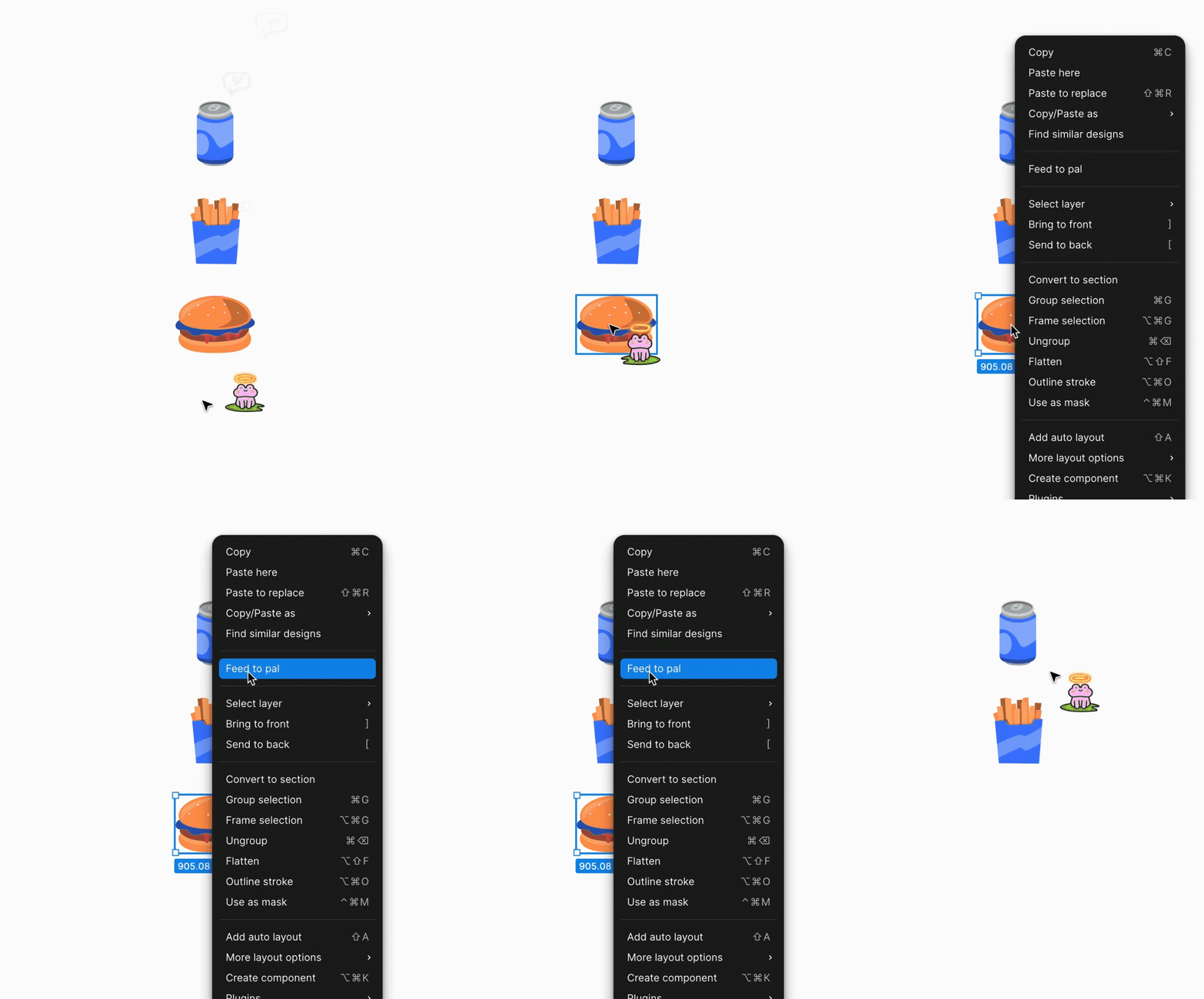
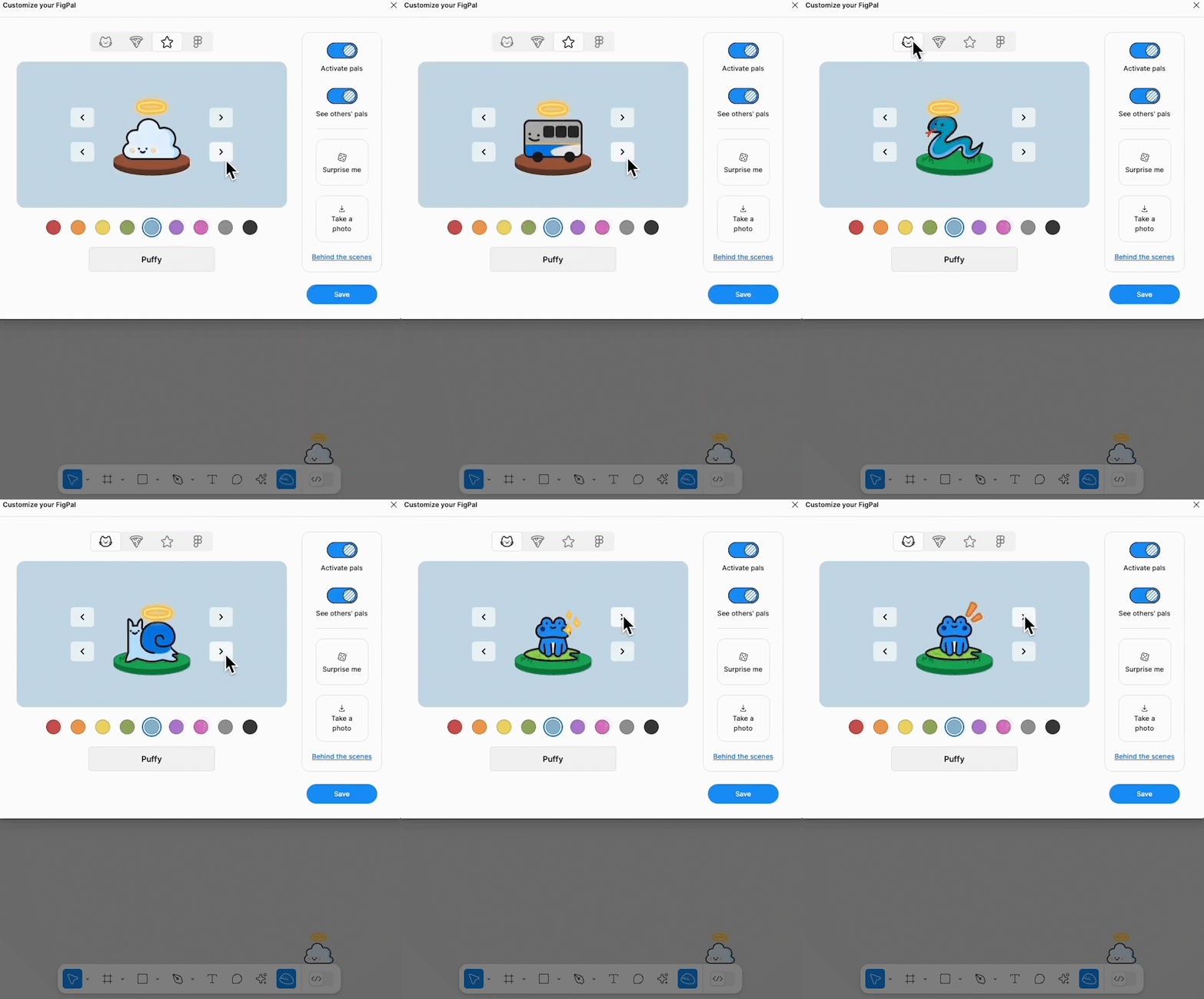
Figpals was so popular that it gathered 3000+ signatures in 9 months for a petition to make the feature permanent. And I saw it as a sign of demand.
Comparing the 3 Products
I was curious how all these three products compare against each other, thus I created comparative analysis of their features.
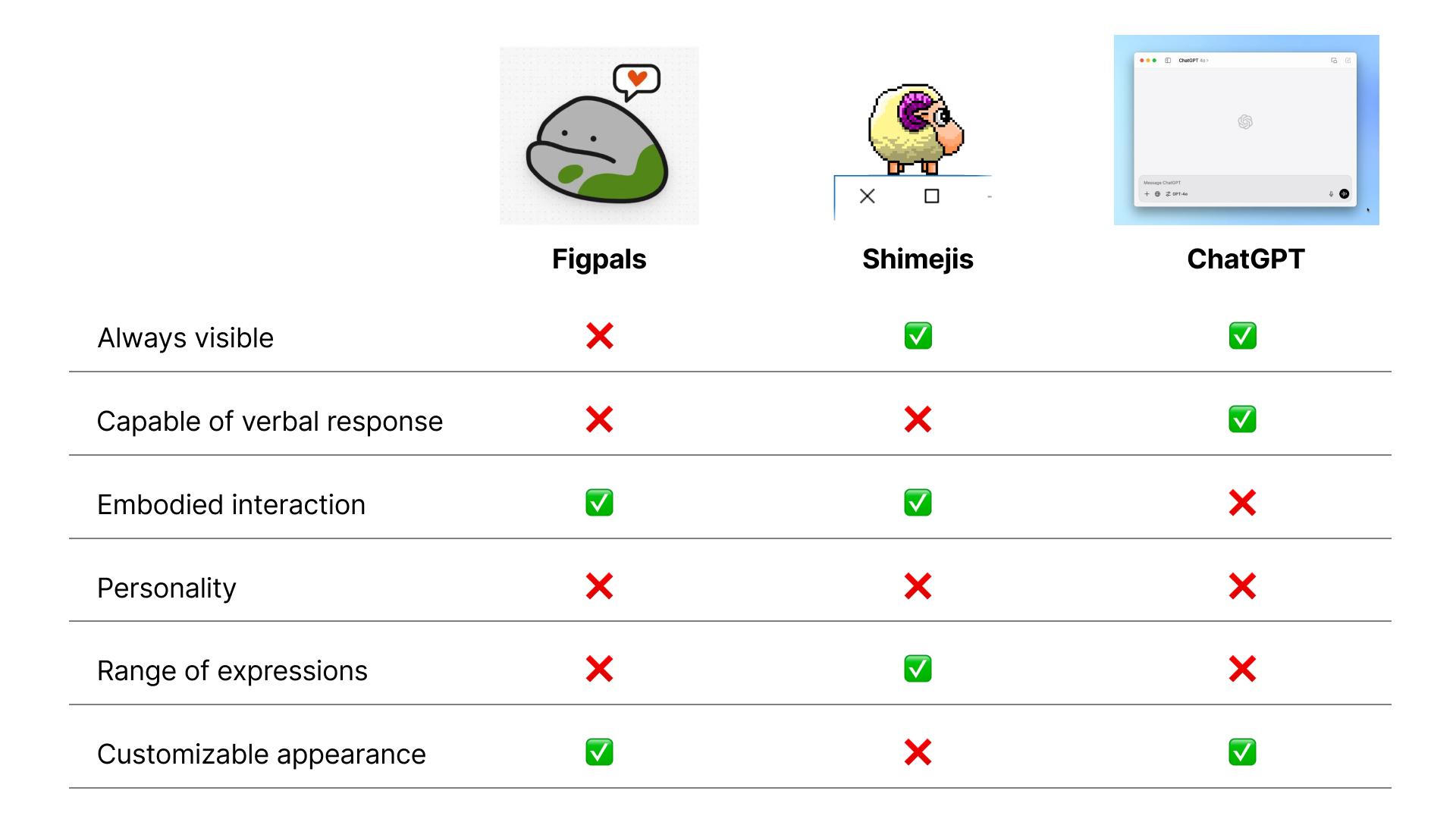
In terms of visibility, Figpals is not visible outside the app, unlike Shimejis and ChatGPT. ChatGPT is the only app capable of verbal response though text and speech. However, it does not have embodied interaction, it cannot be played with or petted with a mouse. All three products also do not have a fixed personality. Only Shimejis have a range of expressions. However, it does not have a customizable appearance, it is worth noting that ChatGPT has very limited customization options, such as simply changing the color of the window.
So, as you can see, all products did not achieve a perfect score. Thus, I propose a product which will.
MiniKin: A New and Improved Desktop Companion
MiniKin is akin to smart pet. How would it achieve the perfect score? It would be:
✅ Always visible → Always sitting on your desktop’s taskbar
✅ Capable of verbal response → It will reply to users when they talk to it
✅ Embodied interaction → Users can pat and feed it
✅ Range of expressions → It shows emotion through facial expressions
✅ Personality → The way it talks and how it is animated show its personality
✅ Customizable appearance → Its appearance can be customizable
What’s with the name?
Minikin is actually a real word! It means ‘a small person or thing’. MiniKin is also a play of the two words: ‘mini’ and ‘kin’. MiniKins are small and friendly critters who are designed to foster companionship with the user, like how a pet bonds with its owner.
Back to the Topic on Emotional Connection
I hypothesize that MiniKin establishes Emotional Connection through the following ways:
Its friendly, silent presence on your desktop..
which cares about you when you need it..
and it reacts to you when you do..
and expresses emotion..
thus forming a companionship between you both..
resulting in a very personal experience!
The Project Plan
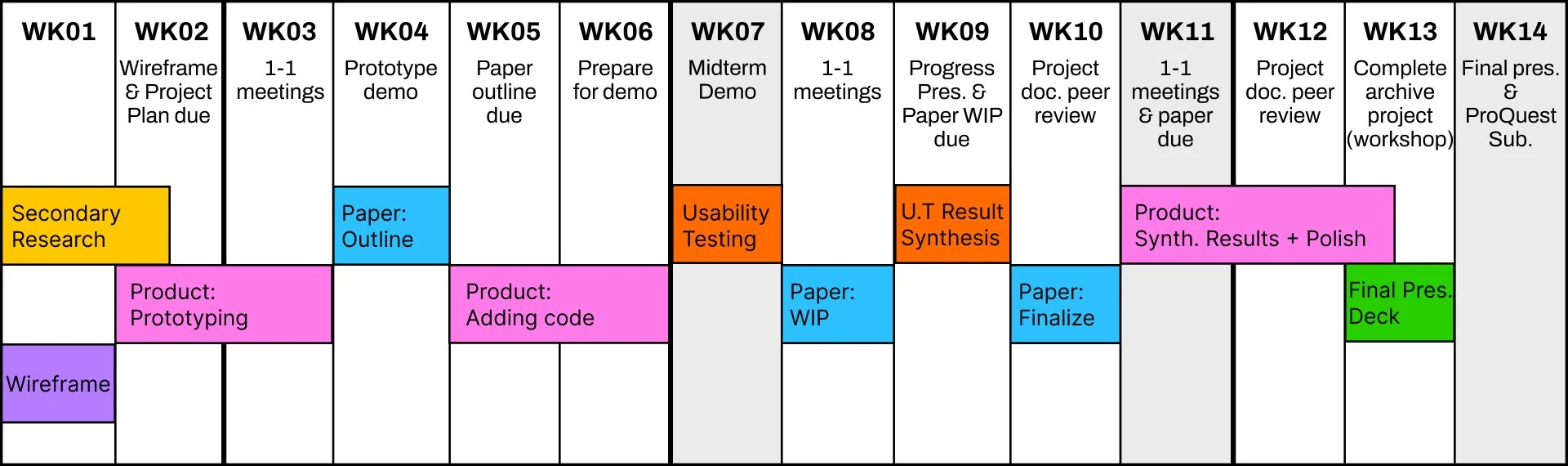
This is a 14-week long project. Shown above is the timeline leading up to the final delivery. To view full project plan in detail, please refer to the slides embedded below.
Week 01 To-do’s
Secondary Research
Aim to unearth the following existing data for:
desktop operating system → PC vs Mac, whoever has the biggest market share holds the largest user pool to develop for
Main reasons people use computers for → This would determine the abilities that the MiniKin would have.
Some examples of MiniKin abilities include:
Health (e.g Timed reminders to hydrate / stretch)
Productivity (e.g To-do list / schedule tracker)
Lifestyle (e.g daily horoscope / weather forecast)
I will also search for articles (preferably peer-reviewed) pertaining to the following research questions:
What interaction patterns and behaviors foster emotional connection over time?
How do virtual pets establish emotional connections with their owners?
How do these emotional connections impact the everyday lives of the virtual pet owners?
Finding the answers to these questions will help me make MiniKin successful in its goal of being both helpful and enduring. I hypothesize that pets establish an emotion connection with their owners through their presence, responsiveness and attention that they give to their human companions. If the MiniKins are able to establish that on top of possessing helpful abilities, it would truly make the product useful and engaging.
Wireframe
Once I have these features down, I will proceed to create a wireframe that visualizes how the product would flow.
Character Designs
I will also be exploring character designs.
Week 01 Progress
Market Share
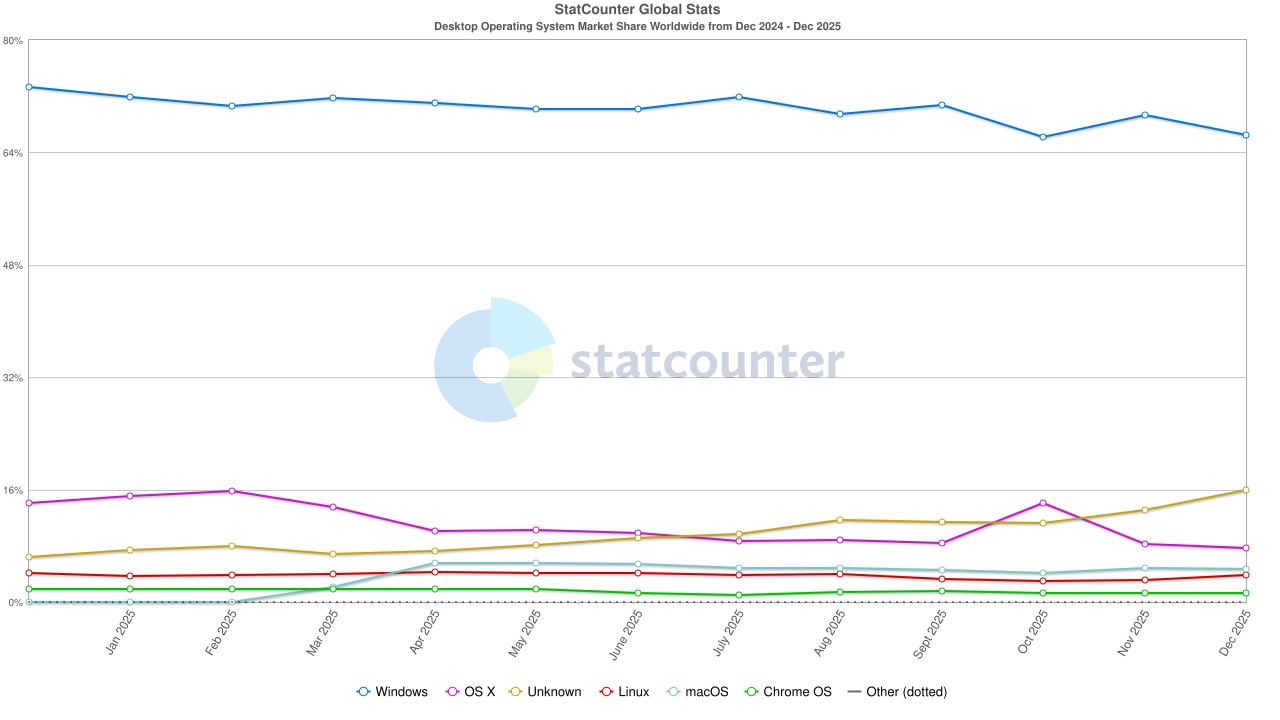
According to statcounter, Windows dominates over Mac in terms of the desktop operating system global market share. Shown in the image to the right, as of December 2025, Windows owns 59.32% of the share, this is followed by OS X at 14.15%.
Based on this data, I have decided to develop MiniKin for Windows users.
Main Reason for Computer Usage
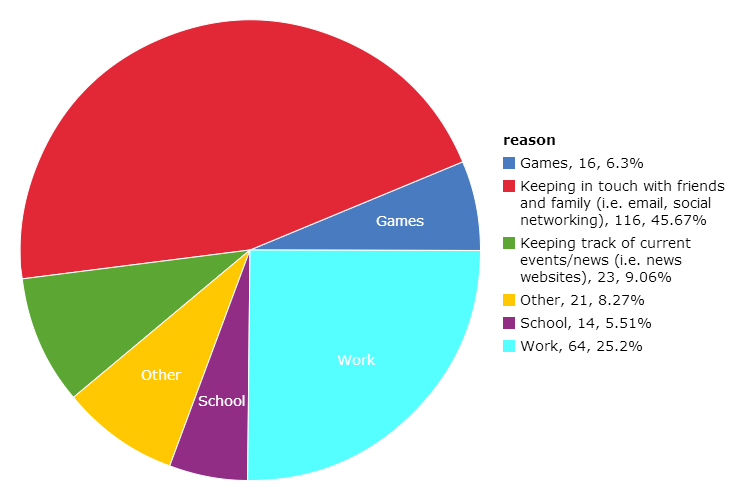
According to a survey on StatCrunch that gathered 251 responses, 46% of respondents indicated that they mainly used their computers for keeping in touch with friends and family such as email, social, and networking. The second most cited reason is work, at approximately 25% of responses.
While it is only natural to gravitate towards the larger demographic, it is worth noting that while fewer respondents cited work as their main reason for computer use, work often involves long periods of focused activity largely devoid of social interaction. I want to target that moment of isolation and explore how MiniKin can provide ambient presence, support and enhance productivity without being intrusive to their hard-working owners.
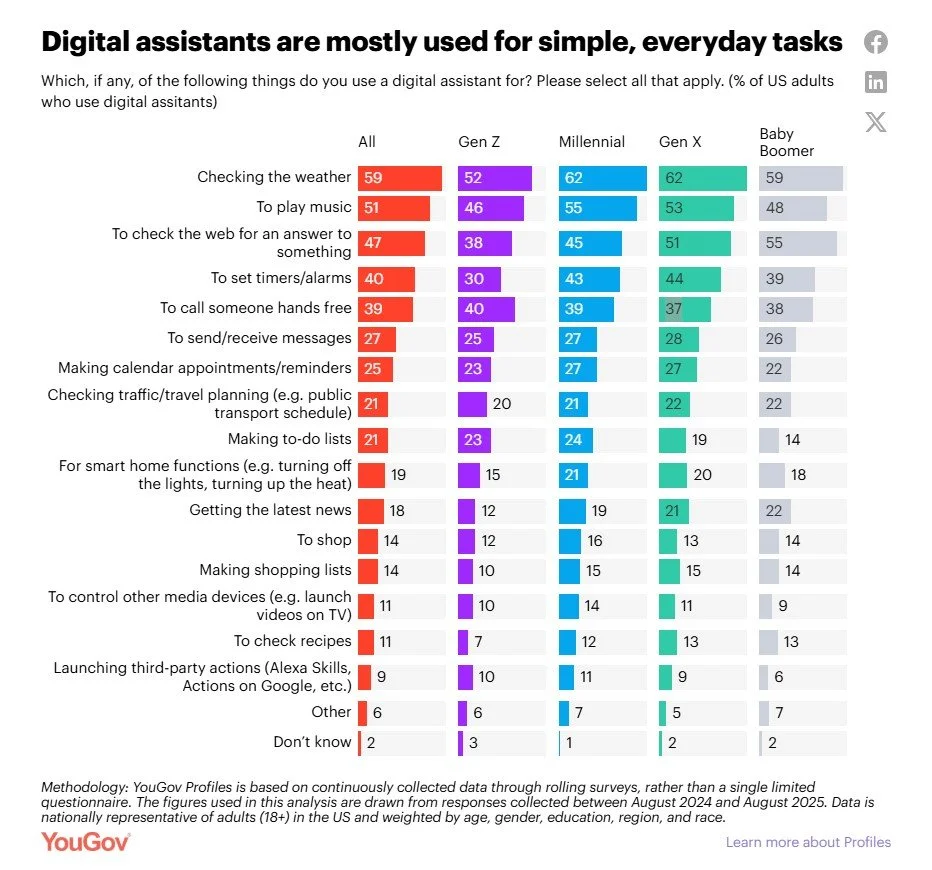
According to a survey by YouGov, digital assistants are usually used for simple tasks, the most common usage being checking the weather (59%). This is followed by playing music (51%), looking up quick answers online (47%), and setting timers or alarms (40%) respectively.
Having this data greatly helps in determining what abilities my MiniKin would have, and tying them with how these abilities would benefit users that usually use their computers for work purposes.
Key Findings Pertaining to Research Questions
This week’s focus was on ‘Virtual Pets’. Below are citations from peer-reviewed articles that could prove useful in the determining the direction I should take when developing MiniKin.
Virtual pets led to an improvement in empathy in those who had had no previous interactions with real pets
A virtual pet may assist habit forming and maintenance, as ‘‘helpers’’ to alleviate loneliness, or through teaching. Virtual pets are viewed as means to motivate healthy behavior.
Attractiveness was the crucial factor for increasing players’ sense of companionship with their online pet
Interactions with animals have been shown to reduce anxiety, loneliness, depression, and stress-related parameters (…) Therefore, HAIs (human-animal interactions) are expected to play a key role in the areas of psychological and psychophysiological well-being.
While HAI can reduce stress in humans, it can also cause increased stress in animals. Additionally, several limitations exist in supporting HAI in universities, such as animal allergies, safety issues, and difficulty in providing the necessary space.
Pet games provide emotional support through pet interaction, without involving animal-related issues, such as allergies
780 adults from 31 countries were invited to partcipate in a study which one of its goals was to describe general features of users interested in playing pet-related games. The majority were either full-time professionals (46.40%).
A certain number of participants played pet games to relax, control their emotion, take responsibility, feel accomplishment, and so on
A certain number of users played pet games simply to kill time. This motivation may be attributed to the simplistic gameplay of most pet-related games.
Three key factors we found to be frequently related to game abandonment were respectively: (1) repetitive and dull in-game activities, (2) lack of attachment to virtual pets, and (3) distractions outside the virtual world.
Character Designs
I started my character design journey with some sketches. I wanted the design of the MiniKin to be kept simple with a bold silhouette so that it does not distract the user, keeping a gentle low profile until they are needed.
This is because I did not want them to be a visual distraction to the user. I am also thinking of visual accessibility, and did not want too much details to overwhelm the user.
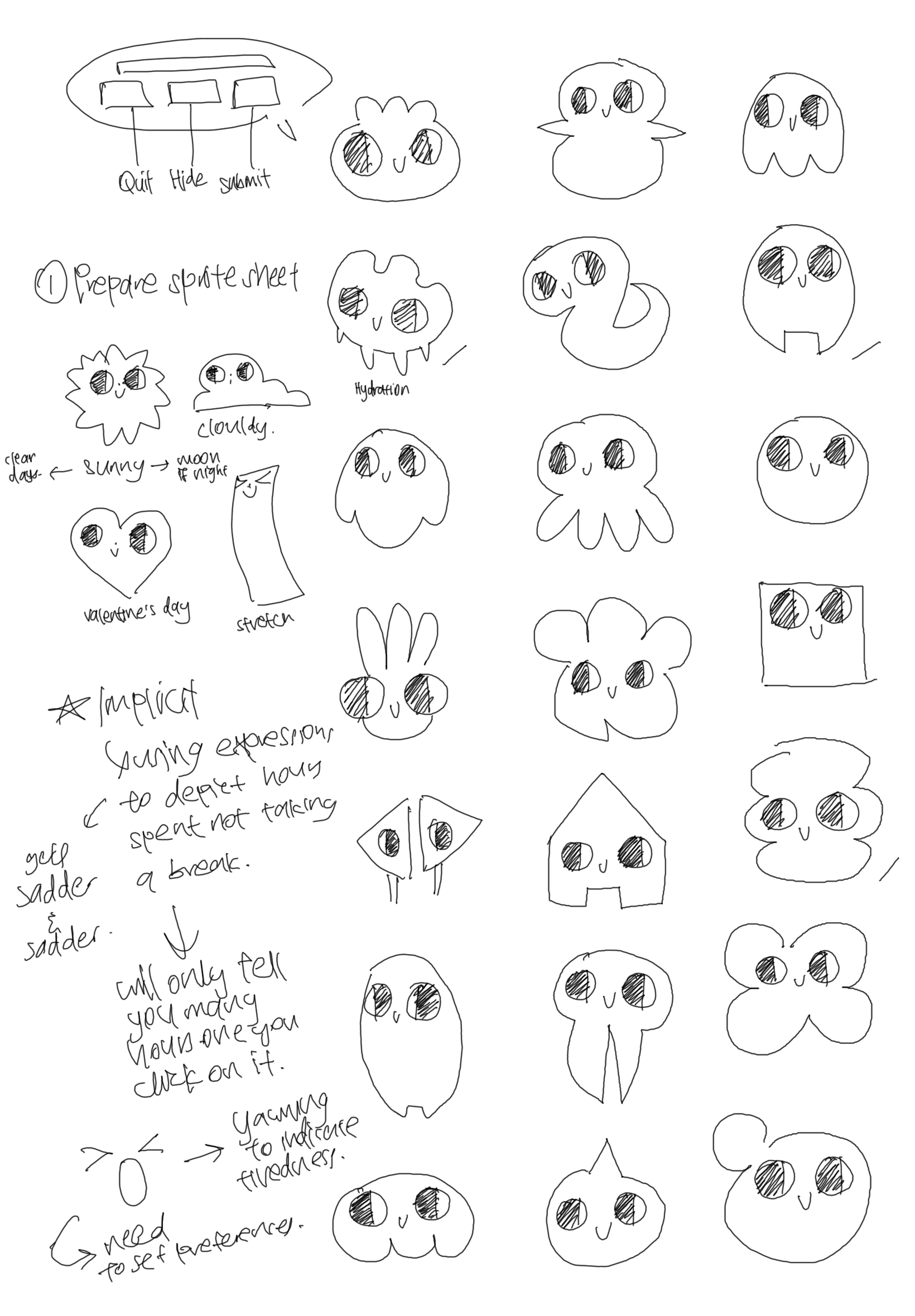
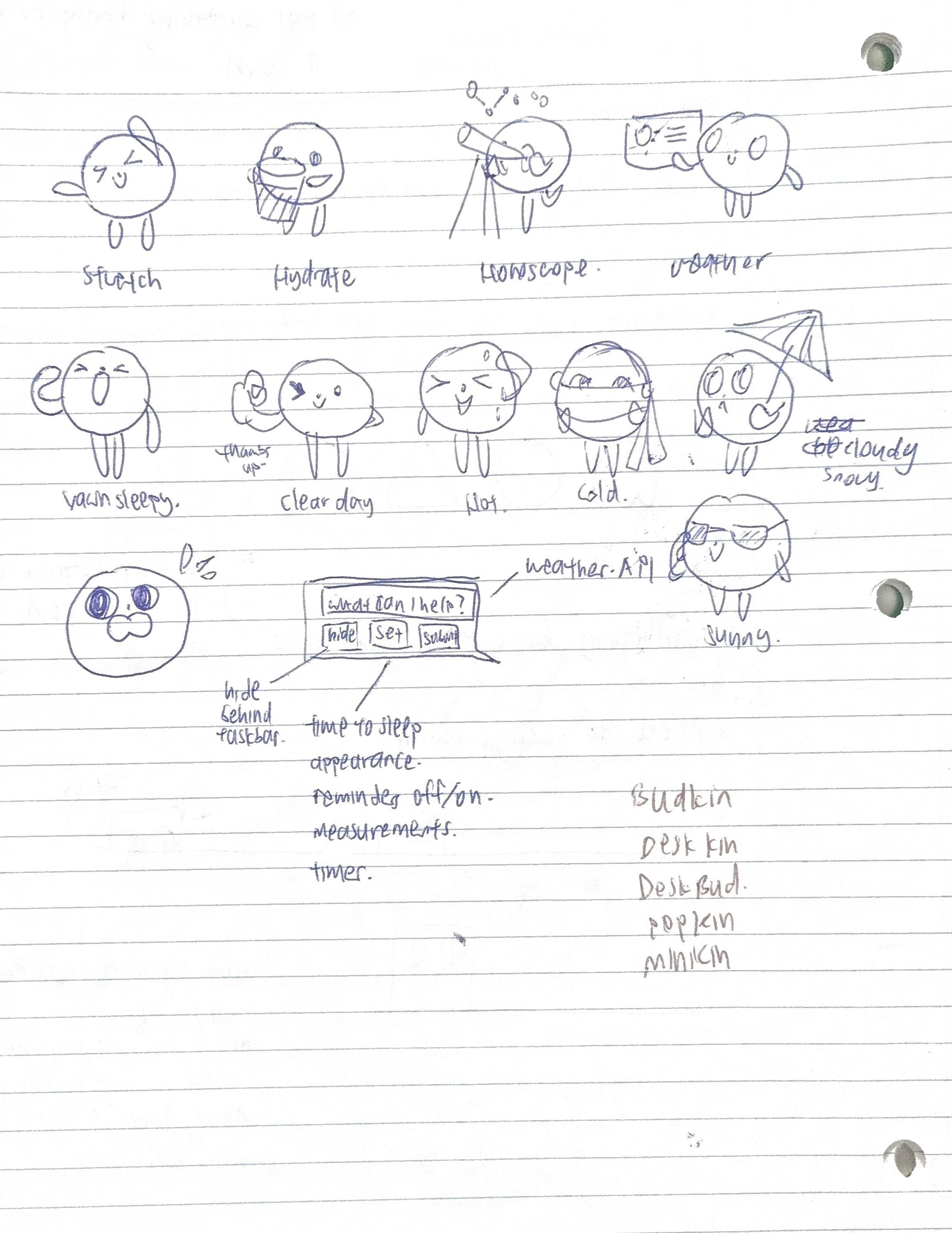
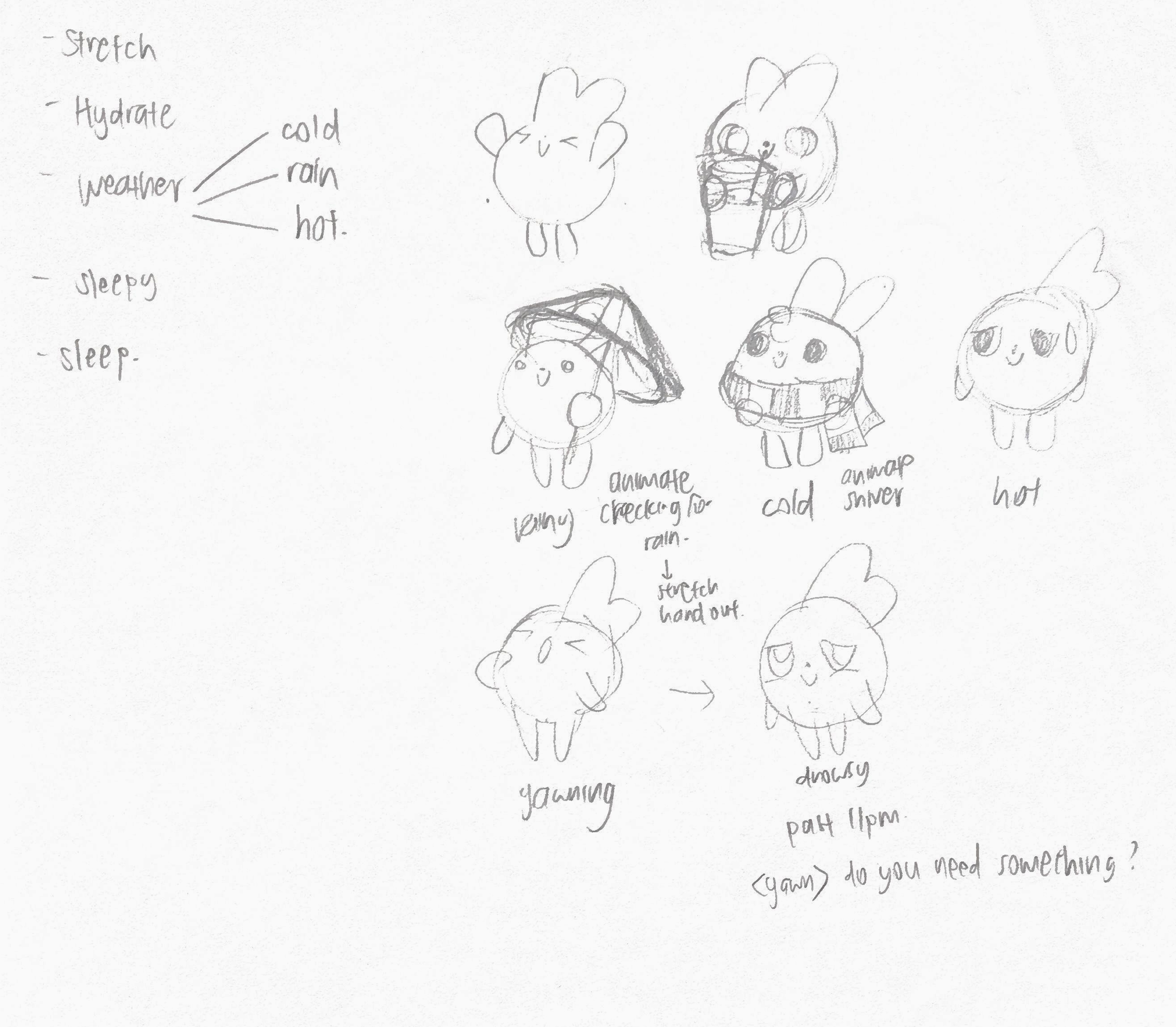
Since MiniKins would be digital, I transitioned sketching to Figma so that I can easily carve out the bold silhouettes I wanted. I also begin playing with color choices there.
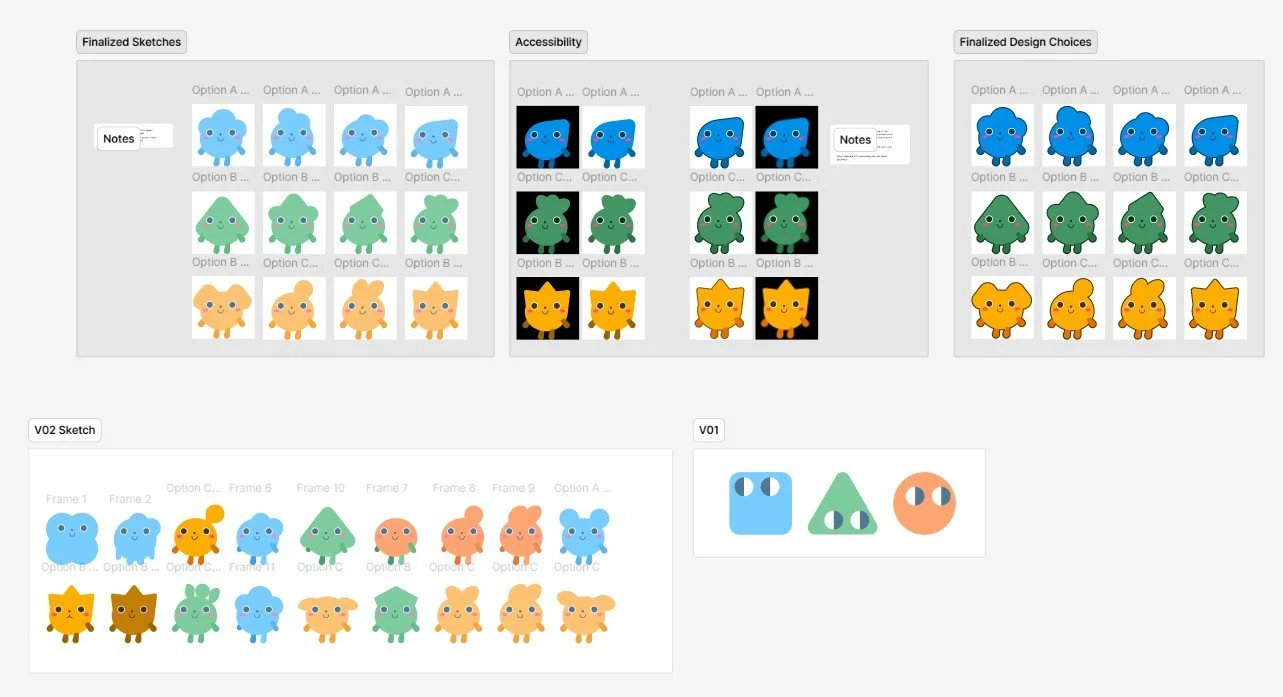
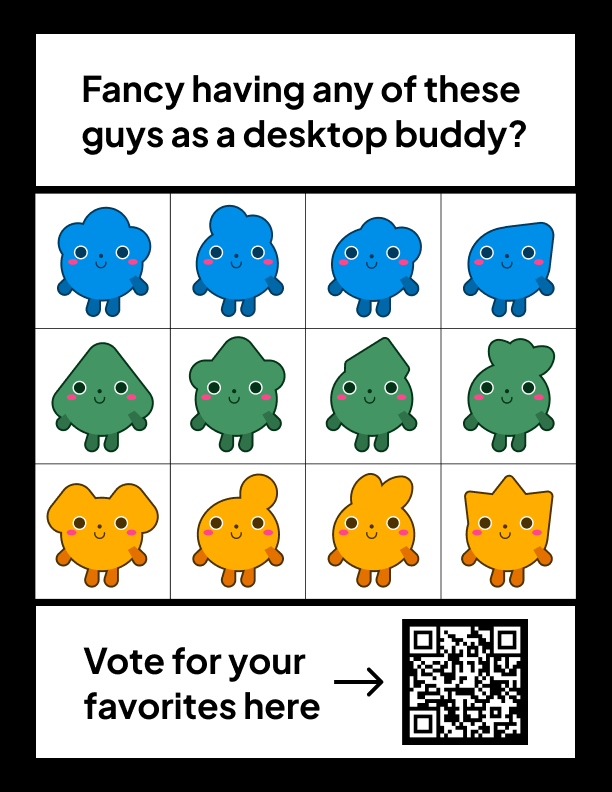
Eventually, I narrowed it down to 3 color colors, with 4 character options for each color. For feasibility purposes, I am aiming to put 3 customizations options into the product for now. To decide on which of these three, I started a survey for responders to pick their favorite character designs.
As stated by Li et al., “Attractiveness was the crucial factor for increasing players’ sense of companionship with their online pet.” Which is why I would implement the majority’s top 3 most favorite designs into app.
Regarding the choice of color, each MiniKin’s entire color palette has high contrast ratio that meets WCAG 2.1 Level AA standards.
The only exceptions are:
Their rosy cheeks, which is purely decorative and do not play a role in communicating his actions or emotions.
The contrast ratio between their body and limbs, since these components function together within each of their poses and are easily distinguishable by their forms, color contrast plays a minimal role.
Wireframe
Show above is my click-through wireframe showcasing how a user could potentially verbally interact with their MiniKin as well as customize their appearances. These features are not finalized and are subject to change as I continue to conduct my research.
When creating my wireframe, I also thought about safe zones, which is essentially areas where the MiniKin should take up without being a disruption to the user. Determining the safe zones also determined the overall size of my MiniKin.
