Week 10 - Thesis Paper Finalization
Analysis of Findings
As my paper reached its final stages, I consolidated and analyzed my findings derived from last week’s design research interviews.
Demographic for Virtual Pets with Implicit Assistive Features
A large majority of participants utilize digital calendars to track birthdays. They also check the weather at least once a day, usually before leaving a location.
Hydration reminders are the most popular feature with most participants noting that having stretch reminders would be use
While none of the participants currently employ any methods to remind themselves to sleep, more than half indicated that the Bedtime Reminders feature would benefit users who work late nights.
Two participants expressing tiredness as they watched MiniKin sleep.
These findings..
Aligned with a previously conducted survey that making calendar appointments or reminders as well as the checking of the weather are the most common requests asked of virtual assistants.
Suggest a demand for features that remind users to hydrate, stretch and sleep.
Suggest that individuals who are more prone to mirroring observed behaviors may be more likely to respond to implicit reminders.
Therefore..
When designing a virtual pet with assistive features, event notifications, wellness check, weather updates and bedtime reminders are features to be considered. These virtual pets would also be better suited for users who work remotely, particularly those who are more prone to mirroring observed behaviors.
Emotional Connection and Implicit Interaction
A participant did not mind having MiniKin around exhibiting the same consistent behavior to remind her to hydrate, despite looking to her cats as reminders telling her to hydrate.
Another participant noted that petting MiniKin would enable her to feel “more connected to him”. This suggests a reciprocation of the care.
Despite a large majority of participants not using an app that deploys hydration and stretching reminders, and that all of them are practicing hydrating diligently, MiniKin’s hydration reminder emerged as the most popular feature.
There was evidence of confusion across all features regarding how they were conveyed through MiniKin’s behavioral cues.
Suggestions from participants on how these cues can be improved were too varied to identify one that could be consistently associated with each feature’s intended function.
All participants noticed him hydrating but not stretching. All participants diligently practice hydration, but only a minority do so for
stretching.
While most participants hydrated based on timed intervals, with half aligning with MiniKin’s scheduled hydration reminders, the participant who hydrated based on task completion did not recognize MiniKin’s hydration reminder.
These findings..
This indicates that programming virtual pets to have assistive features could distinguish them from real-life pets. It also resolves the issue of current pets having a one-sided care dynamic.
Suggests that they enjoyed MiniKin’s presence, even though they did not require the reminder, indicating that even if users do not require all assistive features of virtual pets, their presence is enjoyed nevertheless, sustaining engagement.
Suggest that if a virtual pet’s behavioral cue is associated with a habit that is either absent from the user’s routine or performed in a way that differs from their usual pattern, the user is less likely to interpret it accurately and thus unable to perceive the virtual pet’s responsiveness to their needs.
Therefore..
Virtual pets must produce behavioral cues that are closely aligned with their users’ habits. A lot of data is needed to identify behavioral cues that are widely recognized. Once implemented, these cues can improve perceived responsiveness, contributing to emotional connection.
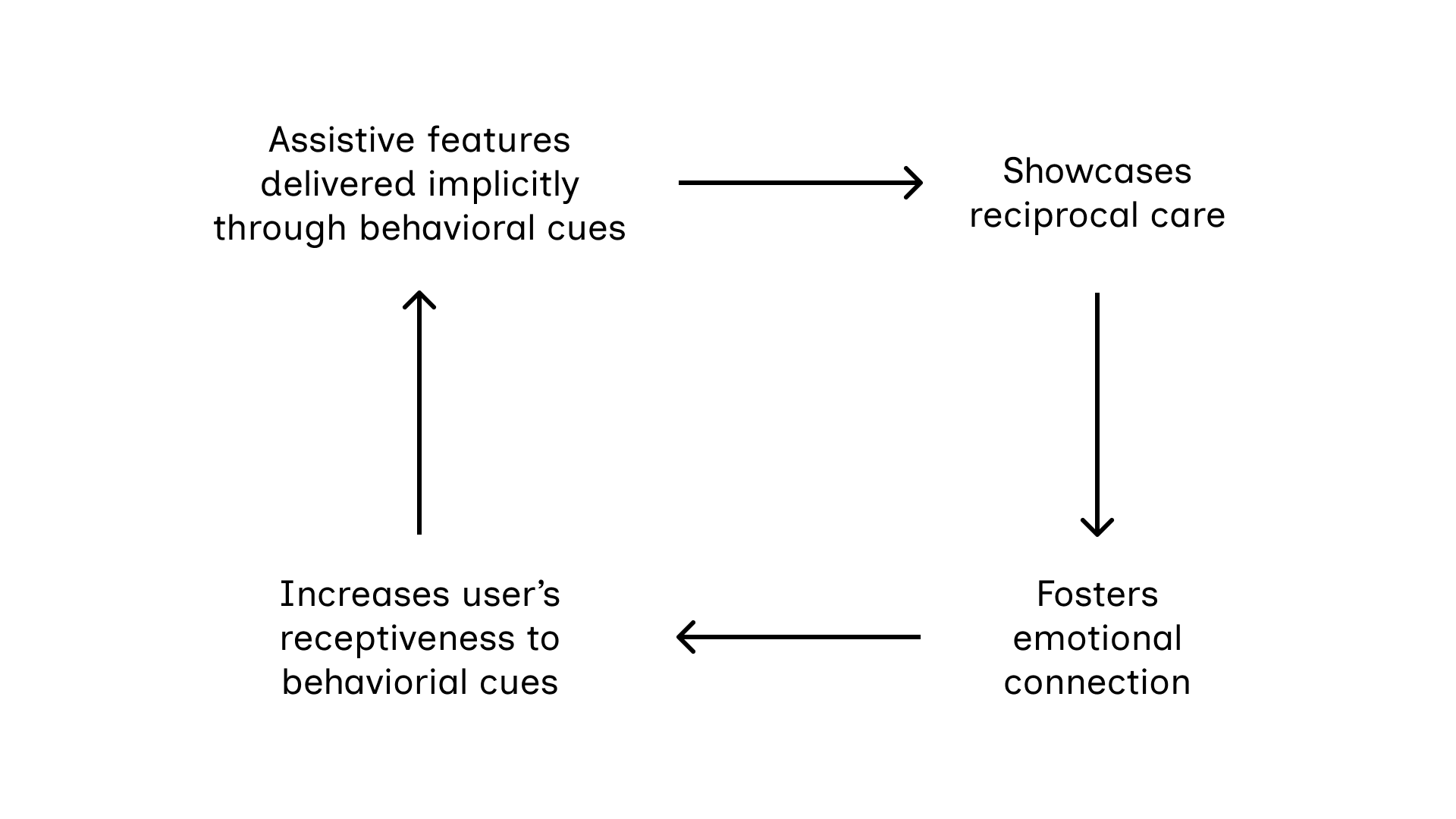
The Cyclical Relationship between Emotional Connection and Implicit Interaction
All participants also openly expressed affection towards MiniKin, referring to it as a “he”.
One participant expressed concern for MiniKin’s apparent discomfort sleeping in a raincoat, suggesting a degree of empathy.
One participant noted he would “feel bad” if he kept MiniKin awake.
These findings..
Indicate that participants perceived MiniKin as a companion rather than an interface, suggesting emotional connection.
Demonstrating that emotional connection may increase users’ receptiveness to a virtual pet’s behavioral cues, enabling them to to carry out their assistive features more effectively.
Therefore..
This suggests that my proposed cyclical relationship between emotional connection and implicit interaction (shown below) may hold, potentially enabling virtual pets to sustain longer-term engagement than conventional interfaces.