
Week 08 - Design Interview Research Plan
Evaluating MiniKin through Interviews
While demo day was invaluable in providing on-the-spot feedback on the current state of MiniKin, I would like to gather more data in a more formal setting moving forward. Thus, I decided to conduct design research interviews in the coming two weeks.
Initially, these interviews were intended to be usability tests. However, usability tests focus on explicit interaction, where users are providing inputs to a product. This does not align with MiniKin’s research goals, where it should be implicitly providing output for its users without relying on any input from them. The interaction between MiniKin and its users should be based off observation and not direct instruction. Thus, design research interviews would be a better in assessing MiniKin’s effectiveness as an implicit interface.
Research Plan
Upon making this decision, I proceeded to create a research plan. This would help me stay aligned with my goals when conducting these interviews.
The following sections provide a summary of the plan, and the full version can be found here.
Background
The purpose of this design research interview is to assess
How participants react to MiniKin
How MiniKin’s current implicit interaction design aligns with participant’s mental models
Research Question
The interviews aim to answer the following research question:
Are users able to correctly associate MiniKin’s behavior to its current features?
These features are:
Event notifications
Weather updates
Wellness checks
Sleep reminders
Recruitment
Approach
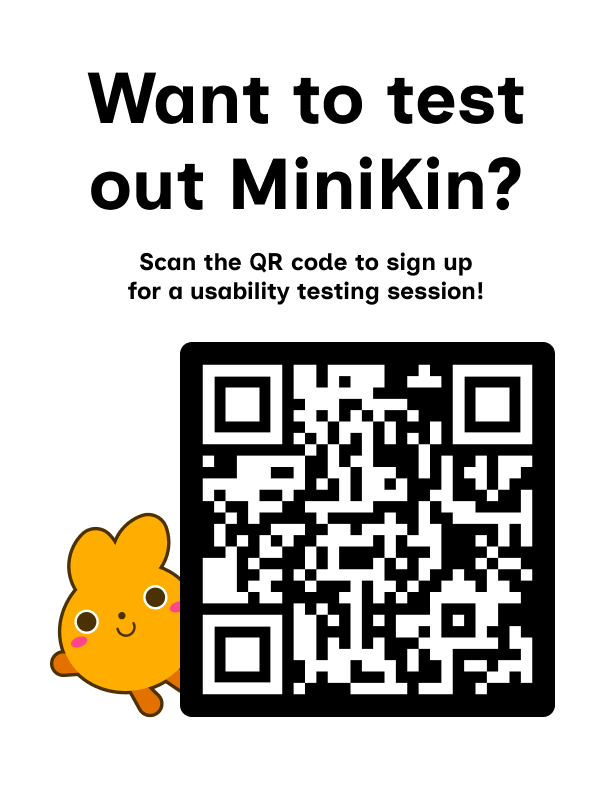
I utilized demo day to recruit participants via an interest form. As shown in the left image, the link to the form was embedded into a QR code, which was printed and displayed at my table showcase. Scanning the QR code immediately loads the form, providing a seamless sign-up experience.
Post-demo day, I discovered a flaw in this approach. Attendees from demo day would have already interacted with MiniKin. In order to achieve more accurate results pertaining to whether MiniKin accurately conveys its behavioral cues to users, participants of the interview must not have had any contact with MiniKin prior to it. Having attendees of demo interact with MiniKin when they already have before would result in inaccurate data as they are already aware of what the behavioral cues entail.
Thus, I revised this approach to instead reach out to individuals that are completely unaware of MiniKin’s existence. This is done though enquiring verbally, followed by providing the link to the Google Form for interested parties to fill out. After they have filled out the form, I proceeded to schedule an interview session with them. A total duration of two weeks have been allocated for this phase to allow flexibility for recruiting and scheduling.
Participant Demographics
The decision to equip MiniKin with features that cater to the lifestyle of working professionals, such as implicit hydration and stretching reminders, is based on findings that work is the second most cited reason for computer use (StatCrunch, 2014). Moreover, based on a survey conducted on 780 adults from 31 countries who are interested in playing pet-related games, 91% were between 18 to 35 years of age, with the majority being full-time professionals (Lin et al., 2017).
Thus, individuals between 18 and 35 years of age who are currently employed or have prior work experience would be the targeted user demographic of this research.
Procedure
The interview is expected to be 45 minutes in duration, and would be carried out in the following sequence.
5 minutes
Introduction to what MiniKin is
For in-person sessions: Set up MiniKin on my laptop
For virtual sessions: Share my screen with participant via Google Meet
30 minutes
Introduce each of the 4 features
For each feature:
What can participants infer from MiniKin’s actions?
How can MiniKin communicate its intention more effectively?
How are participants currently achieving the same intended outcomes?
10 minutes
Ask for feedback on the overall experience
Ask for suggestions on new features participants would like MiniKin to have
Open the floor to questions, further feedback and discussion
Next Steps
At the time of this writing, I have scheduled interview sessions with 7 individuals in the coming two weeks according to plan.
Data yielded from these interview sessions will inform next steps on how I can improve MiniKin, and prioritize them according to feasibility with the time I have left leading up to the final showcase.
